
Artificial intelligence is technology that helps computers perform tasks that normally need human intelligence. It can understand language, recognise images, find patterns, make predictions, solve problems, and create new content.
AI already works inside search engines, navigation apps, email filters, shopping websites, banking systems, customer support tools, and many other services. This guide explains artificial intelligence in simple words, including how it works, its main types, everyday uses, benefits, and risks.
What Is Artificial Intelligence?
Artificial intelligence, commonly called AI, is a branch of technology that enables computers and machines to complete tasks linked with human thinking.
Traditional software usually follows fixed instructions written by a programmer. AI can work differently because it can study examples, recognise patterns, and use what it has learned to handle new information.
For example, a basic spam filter may block an email only when it contains certain words. An AI-based filter can study past messages, learn the common signs of spam, and identify suspicious emails even when the wording changes.
AI does not think, feel, or understand the world exactly like a person. Most AI systems are built for a limited purpose. A system that recommends films may be excellent at that task, but it cannot automatically diagnose an illness or manage a company.
How Does Artificial Intelligence Work?
Artificial intelligence usually works by learning patterns from data. The data may include words, pictures, audio, videos, customer records, sales figures, or readings from machines.
The information is cleaned and organised before training. An algorithm then studies it, finds relationships, and adjusts the model so it can complete a task more accurately. Poor, incomplete, or badly labelled data can lead to weak results.
The model is tested with new information it has not seen before. Once it performs well enough, it can be used to classify images, answer questions, predict demand, recommend products, or flag unusual activity. Its performance still needs checking because data and real-world conditions can change.
AI, Machine Learning, Deep Learning and Generative AI
These terms are connected, but they do not mean the same thing.
Artificial intelligence is the broad field. Machine learning is a part of AI that allows systems to learn from data instead of relying only on fixed rules.
In supervised learning, a system learns from labelled examples. In unsupervised learning, it searches for hidden patterns in unlabelled information. In reinforcement learning, it improves through trial, error, rewards, and penalties.
Deep learning is a specialised form of machine learning. It uses multilayered mathematical structures called neural networks. These networks are loosely inspired by connections between biological neurons, but they do not work like a real human brain. Deep learning is useful for images, speech, video, and natural language.
Generative AI is designed to create new content. It can produce text, pictures, audio, video, code, and summaries after receiving an instruction. It learns patterns from training data and uses them to create a new output rather than simply copying one stored example.
The relationship is simple: AI is the largest field, machine learning is one method inside AI, deep learning is an advanced method inside machine learning, and generative AI uses these methods to create content.
Main 3 Types of Artificial Intelligence
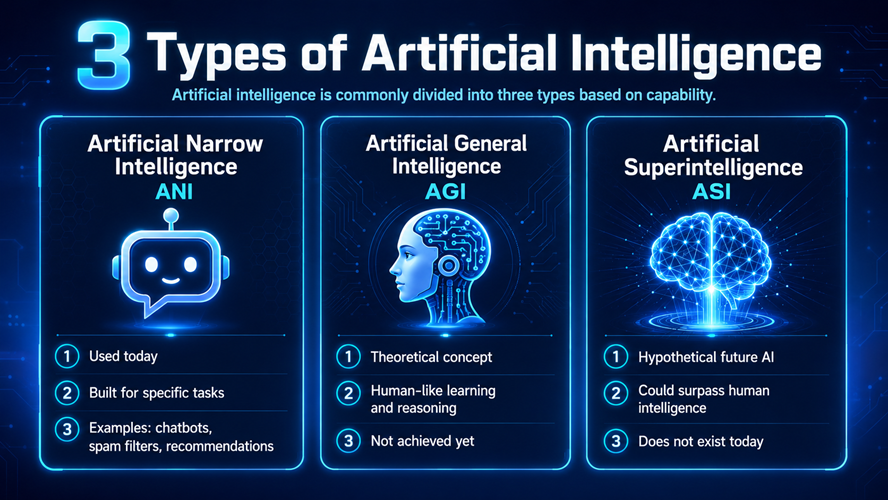
Artificial intelligence is commonly divided into three types based on capability.
1. Artificial Narrow Intelligence
Artificial Narrow Intelligence, also called narrow AI or weak AI, is designed for one task or a small group of related tasks. This is the type of AI used today.
Examples include spam filters, voice recognition, product recommendations, route planning, fraud alerts, image recognition, and customer support chatbots.
Narrow AI may perform its task very well, but it cannot automatically move beyond it. A system trained to recognise damaged products cannot suddenly write a school lesson or plan a holiday.
2. Artificial General Intelligence
Artificial General Intelligence, or AGI, is a theoretical system that could learn, reason, plan, and solve many different problems with flexibility similar to a human.
AGI has not been achieved. Current AI tools can do impressive things, but they still lack broad human understanding, judgement, and common sense.
3. Artificial Superintelligence
Artificial Superintelligence, or ASI, is a hypothetical form of AI that would perform better than humans across areas such as science, strategy, creativity, and reasoning.
ASI does not exist. It is mainly discussed in research, philosophy, future studies, and science fiction. For practical purposes, the AI used today is narrow AI.
Where Artificial Intelligence Is Used
Artificial intelligence is used in many everyday services and industries.
Search systems use AI to understand questions and organise results. Navigation tools analyse road conditions and suggest faster routes. Email platforms identify spam, while shopping and streaming services recommend products, films, or music.
In healthcare, AI can support medical image analysis, appointment scheduling, patient record management, and early risk detection. Healthcare professionals must still review important results and make final decisions.
Banks use AI to detect unusual transactions, assess risk, and identify possible fraud. Retail businesses use it to forecast demand, manage stock, and recommend products.
Educational platforms may suggest lessons based on a student’s progress, create practice questions, and explain difficult topics. Teachers remain important because they understand a learner’s confidence, motivation, and individual needs.
Manufacturing companies use AI to monitor machines, check quality, and predict when maintenance may be required. Transport and delivery businesses use it to plan routes and reduce delays.
Businesses also use AI to answer common questions, organise enquiries, prepare summaries, analyse records, and create first drafts. These outputs should be checked before they are published or used for important decisions. AI is also widely used for customer support, fraud detection, software development, and predictive maintenance.
What Are AI Agents?
An AI agent is a system that can work toward a goal by planning steps, using available tools, and reacting to changing situations.
A basic AI tool may write an email when asked. An AI agent may go further by checking information, choosing the next step, using connected software, and completing part of a process.
For example, an agent could compare calendars, identify an open slot, prepare an invitation, and schedule a meeting if it has permission. Because agents can take actions, they need clear limits, security controls, and human supervision.
Benefits of Artificial Intelligence
One major benefit of AI is speed. It can process a large amount of information much faster than a person.
AI can reduce repetitive work such as sorting documents, entering data, answering basic questions, checking records, and creating routine reports.
It can also provide consistency and round-the-clock support. AI may help people find patterns, predict demand, highlight unusual activity, or identify a possible problem before it becomes serious.
Common benefits include automation, faster insights, decision support, fewer routine errors, and 24-hour availability. These benefits still depend on reliable data, suitable tools, regular testing, and human review.
Risks and Limitations of Artificial Intelligence
AI can make mistakes. It may produce an answer that sounds confident but is incomplete, outdated, or incorrect. Important information should always be checked.
Poor data can also create poor results. If training data contains errors, gaps, or unfair patterns, the AI may repeat those problems.
Privacy and security are major concerns. Personal, customer, employee, or company information should not be entered into a tool without understanding how it will be stored, protected, and used. Connected AI systems may also take unwanted actions if permissions are too broad.
Responsible AI should be fair, transparent, secure, and accountable. People should understand when AI is being used, know its limits, and remain responsible for important outcomes.
Common Misconceptions About AI
AI does not always mean a human-like robot. Most AI works inside software, websites, phones, machines, and business systems.
AI is also not always correct. It may miss context, use weak information, or produce a wrong answer.
Natural-sounding language does not prove that a system has feelings, consciousness, or human-like understanding.
AGI does not exist today. Current systems remain forms of narrow AI, even when they can handle several related tasks.
AI can automate some work, but human judgement, empathy, responsibility, creativity, and experience are still essential.
Final Thoughts
Artificial intelligence helps computers learn from data, recognise patterns, generate content, make predictions, and complete specific tasks.
Most AI used today is narrow AI. Machine learning helps systems learn from information, deep learning handles complex patterns, and generative AI creates new content.
AI can save time, support better decisions, improve services, and reduce repetitive work. It can also make mistakes, repeat bias, and create privacy or security concerns.
The best approach is to use artificial intelligence as a support tool. Clear goals, reliable data, human review, strong security, and responsible decision-making are necessary for gaining real and lasting value from AI.
Frequently Asked Questions About Artificial Intelligence
Q1. What is artificial intelligence in simple words?
Answer: Artificial intelligence is technology that allows computers to perform tasks that normally require human intelligence. It can learn from data, recognise patterns, understand instructions, and make predictions. AI is used in tools such as search engines, voice assistants, recommendation systems, chatbots, and navigation apps.
Q2. What is the difference between AI and machine learning?
Answer: Artificial intelligence is the broader field focused on making machines perform intelligent tasks. Machine learning is one method within AI that allows systems to learn from data without being programmed for every situation. In simple terms, all machine learning is part of AI, but not every AI system uses machine learning.
Q3. What is generative AI?
Answer: Generative AI is a type of artificial intelligence that can create new content after receiving an instruction. It can produce text, images, audio, video, summaries, designs, and software code. The output is generated by recognising patterns learned from large amounts of training data, but it should still be reviewed for accuracy and quality.
Q4. What are the three main types of artificial intelligence?
Answer: The three commonly discussed types are Artificial Narrow Intelligence, Artificial General Intelligence, and Artificial Superintelligence. Narrow AI is designed for specific tasks and is the only type currently in practical use. AGI and ASI remain theoretical concepts and have not yet been achieved.
Q5. Does Artificial General Intelligence exist?
Answer: No, Artificial General Intelligence does not currently exist. Today’s AI systems are forms of narrow AI, designed to perform specific tasks or a limited group of related tasks. Even advanced AI tools do not have the complete understanding, judgement, common sense, and flexibility of a human being.
Related posts:
No related posts.