Search is no longer limited to typing a keyword into Google and clicking one of the top results. People now ask complete questions, use voice assistants, explore AI-generated summaries, and rely on conversational tools to compare products, understand topics, and make decisions. This shift has changed how websites, brands, and content creators need to approach online visibility.
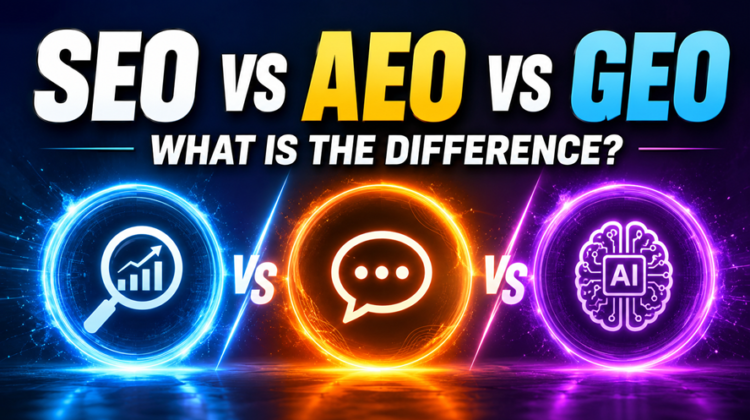
For years, SEO was the main strategy for improving rankings and attracting organic traffic. Today, two newer approaches, AEO and GEO, have become equally important. AEO helps content appear as a direct answer, while GEO helps brands and webpages become part of AI-generated responses. Although these terms are closely connected, each one focuses on a different type of search experience.
Understanding SEO vs AEO vs GEO is essential for any business that wants to remain visible as search continues to evolve. In this guide, you will learn what each approach means, how they work, where they overlap, how they differ, and how to combine them into one effective strategy for traditional search engines, answer engines, and generative AI platforms.
What Is SEO?
SEO stands for Search Engine Optimization. It is the process of improving a website so that search engines can discover, understand, index, and rank its pages for relevant searches.
Traditional search engines generally examine webpages, organise the information they discover, and display relevant results when users search for something. Google explains that its search process includes discovering pages, indexing eligible content, and serving results through its ranking systems. However, following best practices does not guarantee that a page will be indexed or ranked.
The main objective of SEO is to attract relevant organic traffic. Organic traffic refers to visitors who reach a website through unpaid search results rather than advertisements. A business that ranks prominently for valuable keywords can attract potential customers who are already searching for its services, products, or information.
SEO involves much more than adding keywords to an article. It includes technical website accessibility, content quality, search intent, internal linking, page experience, website authority, mobile usability, structured data, and many other factors.
How SEO Works
SEO begins with understanding what users are searching for and why they are searching for it. This is known as search intent. A person searching for “what is digital marketing” is probably looking for educational information, while someone searching for “digital marketing agency near me” may be ready to contact a service provider.
Once search intent is understood, a website can create content that addresses the user’s needs. Search engines then analyse the relevance, usefulness, structure, reliability, and overall quality of the content.
Technical SEO helps search engines access and process the website. This includes maintaining a logical website structure, creating clean URLs, improving loading performance, submitting sitemaps, fixing broken links, using canonical tags correctly, and ensuring important pages are not accidentally blocked from crawling.
On page SEO focuses on the content and elements of an individual webpage. It includes the page title, headings, main copy, image descriptions, internal links, keyword relevance, and the organisation of information.
Off page SEO focuses on external signals that may strengthen a website’s reputation. These can include relevant backlinks, brand mentions, media coverage, industry references, reviews, and discussions about the business across trustworthy websites.
What Is the Main Goal of SEO?
The main goal of SEO is to connect webpages with people who are actively searching for relevant information. Success is usually measured through keyword rankings, organic impressions, clicks, website visits, engagement, leads, conversions, and revenue.
SEO usually encourages the user to click a search result and visit the website. The website then provides the complete information or guides the visitor towards an action such as making a purchase, requesting a quotation, booking an appointment, or subscribing to a newsletter.
What Is AEO?
AEO stands for Answer Engine Optimization. It is the practice of structuring and improving content so that search systems can understand it easily and use it to provide direct answers to user questions.
An answer engine does not always present a list of webpages and ask the user to select one. Instead, it may extract, summarise, or generate an answer directly within the search experience. Examples can include featured snippets, voice assistant responses, knowledge panels, AI summaries, and conversational search results.
AEO is particularly important because search behaviour has become more conversational. Users are increasingly typing or speaking complete questions rather than entering short keyword phrases. They might ask, “What is the difference between SEO and AEO?” rather than searching only for “SEO AEO difference.”
AEO helps content respond clearly to these natural language questions.
How AEO Works
Answer engines attempt to identify the meaning behind a question and locate information that provides a clear, relevant, and reliable response. Content that is confusing, unnecessarily complicated, or poorly structured may be difficult to extract accurately.
AEO content usually presents the main answer close to the question. The answer should be direct enough to understand immediately, while the following paragraphs can provide context, examples, limitations, and deeper explanations.
For example, a page answering “What is local SEO?” should provide a clear definition before discussing local keywords, business listings, customer reviews, location pages, and map visibility. Delaying the answer for several paragraphs can make the content less useful for both readers and answer systems.
Clear headings are especially valuable for AEO because they show how the information is organised. Question based headings can reflect the language users naturally use when searching. However, every heading does not need to be written as a question. Descriptive headings can also work effectively when they accurately represent the section.
Structured data may help search engines interpret certain types of content, such as articles, organisations, products, events, recipes, and frequently asked questions. However, structured data should accurately represent visible page content. It should not be used to make misleading claims or mark information that users cannot see.
What Is the Main Goal of AEO?
The main goal of AEO is to make content easy to select, understand, and present as a direct answer.
Traditional SEO often focuses on obtaining a strong ranking and attracting a click. AEO focuses more strongly on answer visibility, snippet inclusion, voice responses, and accurate extraction.
The user may still visit the website, particularly when the question requires deeper research. However, some simple questions may be answered entirely within the search experience. This means AEO visibility does not always produce the same click through behaviour as a traditional organic result.
What Is GEO?
GEO stands for Generative Engine Optimization. It is the process of improving a brand’s visibility and representation within answers created by generative artificial intelligence systems.
Generative engines do more than extract a short sentence from one webpage. They may collect information from several sources, compare ideas, interpret the question, and produce a new response. The final answer may mention organisations, summarise recommendations, cite webpages, describe products, or explain a subject using information gathered from across the web.
The term Generative Engine Optimization was formally explored in academic research published in 2023. The researchers described generative engines as systems that gather and summarise information from multiple sources and introduced GEO as a framework for improving source visibility within generated responses. Their experimental results showed that some optimization methods increased visibility within the specific testing environment, although results varied by subject area.
GEO has become more relevant as people increasingly use generative platforms for research, comparisons, recommendations, planning, learning, and decision making.
1. How GEO Works
Generative engines can use different methods to produce answers. Some may search the live web, some may retrieve information from an existing index, some may depend partly on model training data, and others may combine several information sources.
Because these systems operate differently, there is no universal formula that guarantees inclusion in every generated response. A brand may appear frequently in one platform but rarely in another. Answers may also change depending on wording, location, available sources, model updates, and the context of the conversation.
GEO therefore requires a broader approach than optimizing a single webpage. It includes publishing useful content on the brand’s website, earning references from trustworthy external sources, maintaining consistent business information, demonstrating genuine expertise, and making claims that can be verified.
Generative systems often need evidence before presenting a brand as a credible recommendation. A company repeatedly describing itself as the best provider is less persuasive than independent sources discussing its services, results, experience, or contribution to the industry.
This makes digital public relations, expert commentary, original research, customer evidence, reputable mentions, and industry participation increasingly important for generative visibility.
2. What Is the Main Goal of GEO?
The main goal of GEO is to increase the probability that a brand or source will be accurately included in an AI generated response.
GEO success may involve being mentioned by name, being cited as a source, being recommended in a comparison, influencing the explanation of a topic, or being represented accurately when users ask about the brand.
Traffic is still valuable, but it is not the only outcome. A user may learn about a company through an AI answer and contact it later through another channel. This makes GEO measurement more complex than tracking a traditional search click.
SEO vs AEO vs GEO: The Core Difference
The simplest difference is the type of visibility each approach primarily targets.
SEO helps a webpage appear prominently in ranked search results. AEO helps content become a direct answer. GEO helps a source or brand become part of a generated response.
SEO is usually page focused. It asks whether a particular webpage can rank for a relevant query. AEO is answer focused. It asks whether information can be extracted and delivered clearly. GEO is source and entity focused. It asks whether a brand, expert, product, organisation, or webpage is considered useful enough to influence a generated response.
SEO commonly measures rankings, impressions, clicks, traffic, and conversions. AEO may measure featured answer visibility, snippet inclusion, voice responses, and question level performance. GEO may measure brand mentions, source citations, recommendation frequency, accuracy, sentiment, and visibility across generative platforms.
These categories are useful for planning, but the boundaries are not absolute. The same article can rank in search results, provide a featured answer, and become a source for an AI generated response.
Is AEO the Same as GEO?
AEO and GEO are often used interchangeably, but a useful distinction can still be made.
AEO is generally concerned with direct answers. It includes traditional answer experiences such as featured snippets and voice results, as well as newer AI based answers. Its primary focus is making information concise, understandable, and easy to extract.
GEO is more specifically associated with generative systems that synthesise information and create new responses. It extends beyond answering one factual question. It may influence product comparisons, brand recommendations, complex explanations, research summaries, and personalised conversations.
AEO can therefore be considered a broader answer focused practice, while GEO concentrates more specifically on generative artificial intelligence experiences. In practical marketing work, however, the techniques overlap considerably.
Google’s official guidance states that established SEO practices remain relevant to its generative Search features because these experiences are connected to core Search ranking and quality systems. Google also notes that AEO and GEO are terms used to describe visibility work for AI search, while treating this work as part of the broader search experience.
Does GEO Replace SEO?
GEO does not replace SEO. In most cases, it depends on many of the same foundations.
Generative search systems often need accessible and understandable web content. If a website cannot be crawled, its pages are not indexed, its information is outdated, or its content lacks credibility, it may struggle in both traditional and generative search.
Strong SEO helps establish the technical and content foundation. AEO improves the clarity and extractability of information. GEO expands the strategy by building wider authority, external validation, and brand recognition.
Businesses that abandon SEO to chase GEO tactics may weaken their overall visibility. Similarly, businesses that focus only on traditional rankings may miss opportunities in conversational and generative discovery.
The more practical approach is to treat SEO, AEO, and GEO as connected layers of one search strategy.
How Content Strategy Changes Across SEO, AEO, and GEO
SEO content strategy begins with search demand and user intent. It identifies the subjects people search for and creates pages that satisfy those needs more effectively than existing alternatives.
AEO adds a stronger emphasis on questions and direct explanations. Important definitions should be easy to locate. Complicated topics should be divided into logical sections. Each section should provide a complete answer rather than relying on vague statements.
GEO adds the need for evidence, originality, and external recognition. Generative systems can summarise generic information from many websites. A page that merely repeats common definitions may offer little reason to be selected as a source.
Original research, expert insights, practical examples, detailed processes, transparent comparisons, useful statistics, and clearly explained experience can make content more distinctive. These elements give other websites a reason to reference the content and give generative systems stronger material to use.
How to Optimize for SEO, AEO, and GEO Together
An integrated strategy begins with creating content for real user needs. Every article should solve a specific problem, answer an important question, or help the reader make a decision.
The page should then be technically accessible. Search engines and other retrieval systems need to reach the content, interpret the page structure, and understand the relationship between different pages on the website.
The introduction should explain the subject clearly and confirm that the page matches the reader’s question. Headings should divide the topic into meaningful sections. Important questions should receive direct answers, followed by detailed explanations.
Claims should be accurate and supported by appropriate evidence. Author information, publication dates, update dates, company details, editorial standards, and source references can help readers assess credibility.
Content should also demonstrate genuine experience. Instead of offering only general advice, it should explain how a process works in practice, what common problems occur, how decisions are made, and what limitations readers should understand.
Brand consistency is equally important. The company name, services, leadership information, location, and positioning should remain accurate across the website, business profiles, media coverage, directories, and trusted industry sources.
External authority should be earned rather than manufactured. Useful research, expert contributions, public relations, interviews, partnerships, and valuable industry resources can generate natural references that support both traditional search authority and generative visibility.
Common Mistakes Businesses Make
One common mistake is treating SEO, AEO, and GEO as completely separate marketing channels. This often leads to duplicated work and inconsistent content. A well-designed article can support all three objectives when it is technically accessible, clearly written, authoritative, and genuinely useful.
Another mistake is believing that keywords are no longer important. Search systems may understand context more effectively than before, but they still need clear language. Important terms should appear naturally in titles, headings, explanations, image information, and related pages.
Some businesses also assume that adding frequently asked questions automatically creates an AEO strategy. An FAQ section can help, but only when the questions reflect real user needs and the answers provide meaningful information.
Another major mistake is publishing large quantities of generic content. Generative systems can already produce basic summaries. Websites need to provide information that adds value through expertise, original evidence, practical detail, or a distinctive perspective.
Businesses should also avoid making unsupported claims merely to influence AI recommendations. Optimization should improve clarity and visibility, not mislead users or manipulate systems with false authority.
How to Measure SEO, AEO, and GEO Performance
SEO can be measured through organic impressions, average rankings, clicks, website sessions, conversions, leads, and revenue. Search analytics tools can show which queries generate visibility and which pages attract visitors.
AEO performance can be assessed by tracking question based searches, featured result appearances, direct answer visibility, and changes in click through behaviour. Manual search testing may also help identify whether content appears in specific answer formats.
GEO measurement is less standardised. Businesses can test relevant prompts across multiple generative platforms and record whether the brand is mentioned, cited, recommended, or described accurately.
Testing should use several versions of the same question because generative responses can change when the wording changes. Tests should also be repeated over time rather than relying on one result.
A recent academic survey noted that GEO remains a developing field with inconsistent terminology, variable results, and limited evidence for universal tactics. It recommended measuring separate outcomes such as discoverability, citation, prominence, factual use, and business impact rather than treating AI visibility as one simple ranking.
The Future of Search Optimization
The future of search is unlikely to involve the disappearance of websites or traditional search results. Instead, discovery is becoming more varied.
Some users will continue to compare several webpages. Others will prefer a direct answer. Some will begin with an AI conversation and later visit a website when they need deeper information, verification, pricing, or professional assistance.
Successful businesses will need to remain visible throughout this journey. They must be discoverable in search results, understandable to answer systems, and credible enough to influence generative responses.
The terminology may continue to evolve, but the central principles are unlikely to disappear. Helpful content, technical accessibility, factual accuracy, expertise, authority, strong brand signals, and a genuine understanding of user needs will remain essential.
Final Thoughts
SEO, AEO, and GEO represent three connected approaches to online visibility. SEO helps webpages rank and attract organic visitors. AEO helps content become a clear and useful direct answer. GEO helps brands and sources become visible within generated responses.
Businesses do not need to choose only one approach. SEO provides the technical, content, and authority foundation. AEO strengthens clarity and answer readiness. GEO expands visibility across generative search experiences by combining valuable content with trusted brand signals and external recognition.
The strongest strategy is not built around acronyms or temporary shortcuts. It is built around understanding how people search, producing genuinely useful information, making that information easy for machines to interpret, and establishing a brand that users and trusted sources recognise as credible.
As search experiences continue to evolve, websites that focus on usefulness, accuracy, accessibility, authority, and clear communication will be best positioned to succeed across traditional search results, direct answers, and generative artificial intelligence platforms.