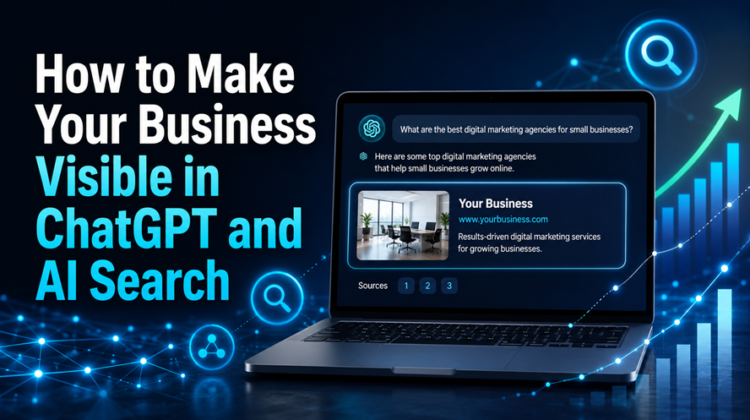
Search is changing from a list of links into a conversation. A customer may ask ChatGPT to recommend a service provider, use Google AI Mode to compare companies, or rely on an AI summary before contacting a business. Visibility now means more than ranking in traditional search results. Your company must also be discoverable, understandable, trustworthy, and useful enough to be cited or recommended in an AI-generated response.
Learning how to make your business visible in ChatGPT and AI Search does not require replacing SEO with tricks. No method can guarantee an AI mention, but the right work can improve eligibility and increase the likelihood that search systems understand and surface your brand.
What AI Search Visibility Means
AI search visibility means that your business, website, products, services, or expert content can appear within conversational search experiences. Your site may be cited as a source, your brand may be named in a recommendation, or information from your pages may support an answer.
Traditional SEO remains important because AI search systems often depend on crawling, web indexes, quality signals, and trusted sources. Google states that its generative AI features are rooted in core Search ranking and quality systems. A page must be indexed and eligible to appear with a snippet before it can be shown as a supporting link in AI Overviews or AI Mode.
ChatGPT search has its own crawl requirements. OpenAI states that any public website can appear in ChatGPT search, but publishers should allow OAI-SearchBot to access pages they want included in summaries, snippets, citations, and links.
An AI search system generally needs to discover a page, understand the business behind it, assess whether the information is reliable, and decide whether the page answers the user’s question. Discovery depends on crawl access and indexation. Understanding depends on clear business details. Trust depends on expertise, evidence, and transparent authorship.
AI Search Visibility Truth Box
- SEO still matters: Google treats optimization for its generative AI experiences as part of SEO.
- There is no guaranteed citation formula: Technical eligibility does not guarantee crawling, ranking, or inclusion in an AI answer.
- Special AI files are not a universal shortcut: Google says llms.txt does not improve visibility in Google Search.
- Original expertise matters: Useful content based on real experience is stronger than large volumes of generic pages.
- Business results matter more than mentions alone: Measure enquiries, conversions, branded searches, and revenue.
Make Your Website Crawlable and Indexable
Begin with technical access. Confirm that priority pages return a successful status code, are not blocked by robots.txt, do not contain an accidental noindex directive, and can be reached through normal internal links.
Submit an XML sitemap to Google Search Console and Bing Webmaster Tools. Inspect important URLs after publishing or updating them. Fix broken canonicals, duplicate pages, redirect chains, server errors, slow loading pages, and mobile usability problems. Bing recommends clear discovery, content structure, authority, and trust signals for visibility across Bing, Copilot, and grounding experiences.
For ChatGPT search, confirm that OAI-SearchBot is not blocked from the public pages you want cited. OpenAI separates search crawling from potential training controls, so blocking GPTBot for training is not the same as blocking OAI-SearchBot from search visibility. OpenAI also adds utm_source=chatgpt.com to referral links, making ChatGPT visits easier to identify.
Use IndexNow when important URLs are created, updated, or removed. It can notify participating search engines about changes more quickly, although submission does not guarantee inclusion or ranking.
Make Your Business Identity Clear
AI systems should not have to guess who you are. Use the same official business name, address, phone number, website, logo, service descriptions, and operating locations across your website, Google Business Profile, trusted directories, social profiles, and industry platforms.
Create a detailed About page explaining the company’s history, leadership, experience, methods, specialist areas, and locations served. Add a clear Contact page, individual service pages, author profiles, customer support details, and relevant policy pages. Avoid relying on promotional slogans that say little about what the company actually does.
Use accurate structured data where it matches visible content. Organization, LocalBusiness, Person, Product, Service, Article, and Breadcrumb markup can add machine readable context. It can support search features, but it does not guarantee an AI citation, and Google says no special schema is required for its AI features.
Local businesses should maintain complete Google Business Profile information, including categories, services, hours, images, contact details, service areas, and genuine reviews. Ecommerce businesses should maintain accurate product data through Merchant Center. Google confirms that these systems can help business and product information appear in traditional and generative search experiences.
Publish Answer First Expert Content
AI search users often ask detailed questions instead of typing short keywords. Your content should cover the customer’s complete decision journey. Explain what the service is, who needs it, how it works, what affects cost, how long it takes, what results are realistic, what alternatives exist, and how a buyer should evaluate providers.
Start each important section with a direct answer in one or two sentences. Follow it with context, examples, evidence, limitations, and practical guidance. This helps readers scan the page and gives search systems a clear passage that can support an answer.
Build topic clusters around core services. A main service page should connect to supporting guides, pricing explanations, comparison pages, case studies, industry pages, and frequently asked questions. Internal links help users navigate and help search systems understand relationships between pages. Google identifies internal linking as a worthwhile practice for AI search eligibility.
Do not create dozens of nearly identical pages for every conversational keyword variation. One comprehensive page can answer many related searches when it is well structured and complete. Google warns that scaled pages created mainly to manipulate rankings or AI responses can violate spam policies.
Create information worth citing. Publish original research, expert commentary, process details, customer insights, industry benchmarks, and case studies with real context. A strong article identifies the author, shows relevant experience, includes a reviewed date, and supports factual claims.
Keep facts precise. Name the service, audience, location, date, method, and outcome. Replace claims such as “we deliver excellent results” with evidence that explains what changed and under what conditions. Support text with useful images, diagrams, screenshots, or videos, but keep essential information in text and add descriptive alt text. Google recommends relevant visual media because generative search is increasingly multimodal.
Strengthen Trust and Verifiability
Authority is built on your website and across the wider web. Add detailed author profiles, company leadership information, editorial standards, correction policies, privacy information, contact details, and evidence for important claims. Update pages when prices, services, regulations, or market conditions change.
Earn genuine mentions from reputable publications, trade associations, partners, review platforms, event websites, podcasts, and specialist directories. These references can confirm that the business exists and is recognised in its field. Avoid manufactured mentions, paid review schemes, and fake testimonials. Google warns that inauthentic mentions are not a reliable shortcut.
Technical SEO makes pages accessible, on page SEO clarifies meaning, local SEO strengthens location signals, digital PR builds authority, and expert content creates answerable passages. AI visibility is an additional outcome of a complete search strategy, not a replacement for traditional SEO.
Measure AI Search Visibility
Track identifiable referral traffic from ChatGPT and other AI platforms. Review engagement, enquiries, conversions, and revenue. OpenAI’s referral parameter makes ChatGPT search traffic easier to recognise.
Use Google Search Console to monitor indexation, queries, pages, countries, devices, and performance. In June 2026, Google announced dedicated generative AI performance reports for a subset of websites. These reports can show impressions, pages, countries, devices, and dates for appearances in AI features, although availability may vary during rollout.
Create a fixed set of realistic customer prompts and test them periodically. Record whether your brand appears, which competitors appear, which pages are cited, and whether the answer describes your business accurately. Treat this as directional research because responses can vary.
During the first month, fix crawl access, sitemaps, canonicals, mobile usability, internal links, and crawler access. During the second month, improve service pages, entity information, author profiles, schema, local profiles, and question-based content. During the third month, publish a strong case study, earn relevant coverage, improve review collection, analyse referrals, and update pages that AI systems misunderstand.
Common Myths About AI Search Optimization
1. Does llms.txt Guarantee AI Visibility?
No. Some services may use it, but Google says llms.txt does not improve rankings or visibility in Google Search.
2. Does Schema Guarantee a Citation?
No. Schema can clarify page meaning and support search features, but it cannot force an AI system to select a page.
3. Must Every Paragraph Be Extremely Short?
No. Clear structure helps, but content should be as long as needed to satisfy the reader. Google says there is no ideal page length and no requirement to divide content into tiny chunks.
4. Will Keyword Repetition Increase AI Mentions?
Not reliably. Search systems understand related language and meaning. Repetition that damages readability can weaken a page.
5. Can an Agency Guarantee ChatGPT Placement?
No legitimate provider can guarantee an organic citation or recommendation. Be cautious of claims involving secret ranking access or fixed AI positions.
Internal Linking Opportunities
Link the phrase technical SEO to an audit or technical SEO service page in the crawlability section. Link local SEO and Google Business Profile optimization in the business identity section.
The phrase content marketing strategy can link to a supporting content guide, while structured data can link to a detailed schema guide. Link digital PR to an authority building or media coverage page. Near the conclusion, link AI search optimization to the primary commercial service page.
These links should lead to genuinely useful pages rather than being added only for keyword purposes. The anchor text should accurately describe the destination and fit naturally within the sentence.
Final Thoughts
Making your business visible in ChatGPT and AI Search is not about discovering a secret file, prompt, or schema. It is about becoming a clear, useful, trustworthy, and verifiable source for the questions your customers ask.
Make your website accessible, define the business consistently, publish expert answers, support claims with evidence, earn authentic recognition, and measure business outcomes. These improvements strengthen traditional SEO while increasing the chance that AI search systems can understand, cite, and recommend your brand.
Frequently Asked Questions
Q1. How Do I Get My Business Listed in ChatGPT?
Answer: There is no manual listing form that guarantees inclusion. Allow OAI-SearchBot to access public pages, publish clear information, strengthen trusted references, and maintain consistent business details.
Q2. Can ChatGPT Find a New Website?
Answer: It can potentially surface a new public website, but discovery and citation are not guaranteed. New sites should prioritise crawl access, sitemaps, internal links, original content, and external authority.
Q3. What Content Performs Best in AI Search?
Answer: Content performs best when it directly answers a real question, adds original expertise, identifies relevant entities clearly, includes verifiable facts, and provides more value than a generic summary.
Q4. Is AI Search Optimization Different From SEO?
Answer: It adds attention to conversational answers, citations, entity clarity, and source selection, but it still depends on SEO fundamentals. Google states that optimization for its generative AI search experiences remains SEO.
Q5. How Long Does AI Search Visibility Take?
Answer: There is no fixed timeframe. Results depend on crawling, competition, content quality, authority, and how quickly systems process changes.