
Digital marketing is often associated with search engine optimisation, social media marketing, paid advertising, email campaigns, and content creation. However, all these activities usually lead people to one central destination: the website. This makes web design one of the most important elements of a successful digital marketing strategy.
A business can invest heavily in advertising and attract thousands of visitors, but those visitors may leave quickly if the website is slow, confusing, outdated, or difficult to use. On the other hand, a professionally designed website can turn visitors into leads, enquiries, subscribers, and customers.
Web design is not limited to choosing colours, fonts, and images. It includes the entire experience a visitor has on a website. It determines how easily people can find information, understand a business, trust its services, and complete an action.
For this reason, web design and digital marketing should never be treated as separate activities. Digital marketing brings people to the website, while web design helps convert that traffic into meaningful business results.
Web Design Creates the First Impression of a Business
A website is often the first interaction a potential customer has with a company. Before speaking to a sales representative, visiting an office, or purchasing a product, people usually explore the business online.
The appearance of a website immediately influences how visitors feel about the brand. A clean, modern, and professional website creates a positive impression. It suggests that the business is organised, trustworthy, and serious about its customers.
An outdated or poorly designed website creates the opposite effect. Visitors may assume that the business is inactive, unreliable, or unable to deliver quality services. Even when the company provides excellent products, weak design can prevent potential customers from discovering that value.
First impressions are particularly important in competitive industries. When several businesses offer similar services, users often compare their websites before making a decision. A well designed website can help a company appear more credible and capable than its competitors.
Web Design Builds Trust and Credibility
Trust is one of the most important factors in online decision making. Visitors cannot always meet the business owner or inspect the product personally, so they rely on the website to judge whether the company is genuine.
Professional web design builds trust through consistent branding, accurate information, clear contact details, quality images, customer reviews, and secure browsing. Every part of the website should make visitors feel confident.
Simple details can influence credibility. Broken links, spelling mistakes, poor quality images, confusing menus, and outdated information can create doubt. Visitors may hesitate to fill out a form, make a payment, or share personal information if the website does not feel secure.
A trustworthy website also explains the business clearly. Visitors should understand who the company is, what it offers, how it works, and how to contact it. Transparency reduces uncertainty and helps customers feel comfortable taking the next step.
Web Design Improves the User Experience
User experience refers to how easy and enjoyable it is for visitors to use a website. Good web design focuses on the needs of the user and removes unnecessary difficulties.
Visitors should be able to find important information without searching through multiple pages. Navigation should be clear, page layouts should be organised, and content should be easy to read.
A complicated website can frustrate users. When menus are confusing, buttons are difficult to locate, or important information is hidden, visitors may leave and look for another company.
Good user experience also means creating a natural journey through the website. A visitor may begin on the home page, move to a service page, read customer testimonials, and then complete a contact form. The design should guide this journey smoothly.
The easier the website is to use, the more likely visitors are to stay, explore, and convert.
Web Design Supports Search Engine Optimisation
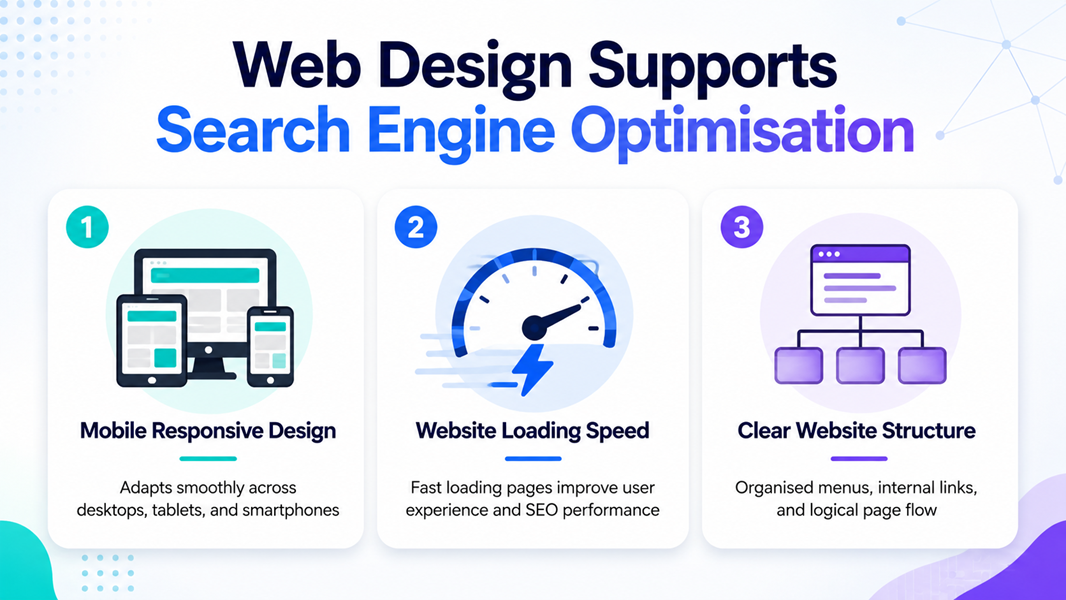
Web design has a direct relationship with search engine optimisation. Search engines want to provide users with websites that are useful, accessible, and easy to navigate.
A website may contain valuable content, but poor technical design can make it difficult for search engines to understand and rank that content. Slow loading pages, weak mobile design, confusing site structure, and broken links can negatively affect visibility.
1. Mobile Responsive Design
A responsive website automatically adjusts its layout according to the screen size. It should work properly on desktop computers, laptops, tablets, and smartphones.
Mobile responsiveness is essential because a large number of users search, browse, and purchase through mobile devices. If visitors need to zoom in, scroll sideways, or struggle to tap buttons, they are unlikely to stay.
A responsive design improves readability, navigation, engagement, and search performance. It ensures that every visitor receives a consistent experience, regardless of the device they use.
2. Website Loading Speed
Website speed is another major factor in both user experience and SEO. Visitors expect pages to load quickly. When a website takes too long, users may leave before the content appears.
Good web design supports speed by using properly compressed images, clean code, efficient layouts, and limited visual effects. Large images, unnecessary animations, and heavy scripts can reduce performance.
A fast website keeps visitors engaged and allows them to move smoothly from one page to another.
3. Clear Website Structure
A well organised website helps search engines understand how pages are connected. Clear menus, descriptive headings, internal links, and logical categories make content easier to discover.
For example, a web design company may have separate pages for website development, ecommerce design, WordPress services, and website maintenance. Each page should have a clear purpose and should connect naturally to related content.
This structure improves search visibility and helps visitors find the information they need.
Web Design Helps Convert Visitors Into Customers
Traffic alone does not create business growth. A website may receive thousands of visitors, but those visits have limited value if users do not take action.
Conversion focused web design encourages visitors to complete important actions. These actions may include requesting a quote, calling the business, booking a consultation, purchasing a product, joining an email list, or downloading a resource.
The design should make these actions simple and obvious. Calls to action should be placed where visitors naturally expect them. Buttons should use clear language, such as Request a Quote, Book a Consultation, Contact Us, or Get Started.
Forms should also be easy to complete. Asking for too much information can discourage users. A simple form with clear labels and only essential fields usually creates a better experience.
The design should remove distractions and guide visitors toward the most important action on each page.
Web Design Improves Landing Page Performance
Landing pages play an important role in paid advertising and lead generation. When someone clicks an advertisement, the landing page should immediately continue the message shown in the advertisement.
If the advertisement promotes affordable website design, the landing page should focus on that specific service. Sending the visitor to a general home page may create confusion.
A successful landing page usually includes a strong headline, a clear explanation of the offer, visible benefits, customer proof, and a direct call to action. The layout should remain focused on one goal.
Poor landing page design can waste advertising money. Businesses pay for every click, but a confusing or slow page may cause visitors to leave without converting.
Improving the design of a landing page can increase leads without increasing the advertising budget.
Web Design Strengthens Brand Identity
A website is one of the strongest representations of a brand. Its colours, fonts, images, tone, and overall appearance communicate the personality of the business.
Consistent design helps people recognise and remember the brand. A business that uses the same visual identity across its website, social media pages, advertisements, emails, and marketing materials appears more professional.
The design should also match the brand position. A luxury company may use elegant typography, spacious layouts, and premium images. A technology company may use modern visuals and interactive elements. A local service business may focus on trust, simplicity, and clear contact information.
Strong brand identity helps a company stand out and creates a more memorable experience.
Web Design Makes Content Marketing More Effective
Content marketing attracts visitors by providing useful information. Blog articles, guides, case studies, service pages, and educational resources can improve search visibility and establish authority.
However, content quality alone is not enough. The design must make the content easy to consume.
Long paragraphs without spacing, unclear headings, poor contrast, and small text can make even valuable information difficult to read. A good layout uses clear headings, comfortable spacing, readable fonts, and relevant visuals.
The design should help readers understand the flow of the article. Important sections should be easy to identify, and related pages should be linked naturally.
A well designed blog can encourage visitors to read more articles, explore services, subscribe to updates, and return to the website later.
Web Design Supports Social Media Marketing
Social media campaigns often direct users to a website. A social post may create curiosity, but the website must provide complete information and a clear next step.
The transition from social media to the website should feel consistent. If a campaign uses a particular message, image style, or offer, the landing page should continue the same experience.
Visitors arriving from social media may have shorter attention spans. The page should quickly explain what is being offered and why it matters.
Mobile design is especially important for social media traffic because many people access social platforms through smartphones. A page that does not work properly on mobile can reduce the effectiveness of the entire campaign.
Web Design Improves Email Marketing Results
Email marketing often encourages subscribers to visit a product page, blog post, landing page, or contact form. The success of the email depends partly on the quality of the destination page.
A strong email may create interest, but visitors can still leave if the website looks unreliable or does not match the message. The design should maintain consistency between the email and the landing page.
If an email promotes a limited offer, the website should clearly display the same offer. If the email invites users to register, the registration process should be simple.
Good web design helps email campaigns generate more clicks, conversions, and customer engagement.
Web Design Reduces Bounce Rates
Bounce rate refers to visitors leaving a website after viewing only one page. A high bounce rate can indicate that users did not find the page useful, relevant, or easy to use.
Poor design is a common reason for early exits. Slow loading times, cluttered layouts, intrusive popups, confusing navigation, and irrelevant content can cause visitors to leave.
A well designed website encourages people to stay longer. Clear headings, useful information, internal links, and engaging layouts invite users to explore additional pages.
Lower bounce rates can improve the overall performance of digital marketing campaigns because more visitors interact with the website instead of leaving immediately.
Web Design Supports Local Digital Marketing
For local businesses, the website often plays an important role in generating calls, visits, and enquiries. People searching for nearby services want quick and accurate information.
A local business website should clearly display its service areas, address, contact number, working hours, and directions. These details should be easy to find, especially on mobile devices.
Service pages can target specific locations and answer common customer questions. Testimonials from local clients can also increase trust.
A clear and professional website helps local businesses compete more effectively in search results and convert nearby users into customers.
Web Design Provides Valuable Marketing Data
A well structured website makes it easier to understand user behaviour. Analytics tools can show which pages visitors view, how long they stay, where they leave, and which actions they complete.
This information helps businesses improve their marketing strategies. If many visitors leave a form before submitting it, the form may be too long. If a service page receives traffic but few enquiries, the message or call to action may need improvement.
Web design should not remain unchanged forever. Regular analysis allows businesses to test layouts, headlines, forms, buttons, and content placement.
Continuous improvement helps the website become more effective over time.
Web Design Makes Digital Marketing More Cost Effective
Businesses often focus on increasing website traffic, but more traffic does not always mean more sales. Sometimes, the better solution is improving the website so that existing visitors convert at a higher rate.
A business may increase results by improving page speed, simplifying navigation, adding clearer calls to action, strengthening trust signals, and making forms easier to complete.
These improvements can increase the return from search engine optimisation, paid advertising, social media, and email marketing without requiring a major increase in marketing spending.
A well designed website continues to create value throughout the day. It can explain services, answer questions, collect enquiries, showcase work, and support customers even when the business is closed.
How to Align Web Design With Digital Marketing Goals
A website should be designed around clear business goals. Before creating pages, the business should decide what actions it wants visitors to take.
The home page may introduce the company, service pages may generate enquiries, blog posts may attract search traffic, and landing pages may support advertising campaigns.
Designers, marketers, SEO professionals, and content writers should work together. The website layout should support the content, and the content should support the customer journey.
Regular updates are also important. Customer expectations, search behaviour, technology, and business goals change over time. A website should be reviewed and improved to remain relevant and competitive.
Final Thoughts
Web design is a fundamental part of digital marketing success. It affects how people see a brand, how easily they use the website, how much they trust the business, and whether they decide to take action.
Search engine optimisation, paid advertising, social media marketing, content marketing, and email campaigns can attract visitors, but the website must convert those visitors into meaningful results.
A professionally designed website improves first impressions, strengthens credibility, supports search rankings, enhances content, increases conversions, and makes marketing campaigns more cost effective.
Businesses that treat web design as a strategic marketing investment are more likely to create stronger customer experiences and achieve long term growth. A website should not simply look attractive. It should communicate clearly, perform efficiently, support marketing goals, and guide every visitor toward the right next step.
Frequently Asked Questions About Web Design
Q1. Why is web design important for digital marketing?
Answer: Web design is important because it turns digital marketing traffic into leads, sales, enquiries, and customer relationships. It influences trust, usability, SEO, engagement, and conversions.
Q2. How does web design affect SEO?
Answer: Web design affects SEO through website speed, mobile responsiveness, navigation, content structure, internal linking, accessibility, and user experience.
Q3. Can poor web design affect sales?
Answer: Yes. Poor design can make visitors feel confused or uncertain. If the website looks outdated, loads slowly, or makes actions difficult, users may leave without purchasing or contacting the business.
Q4. What makes a website effective for digital marketing?
Answer: An effective website is fast, responsive, easy to navigate, visually professional, content rich, trustworthy, and designed around clear conversion goals.
Q5. Why is mobile responsive web design necessary?
Answer: Mobile responsive design ensures that a website works properly on smartphones and tablets. It improves user experience, search visibility, engagement, and conversions.